




What makes the game more than a Zeus skin
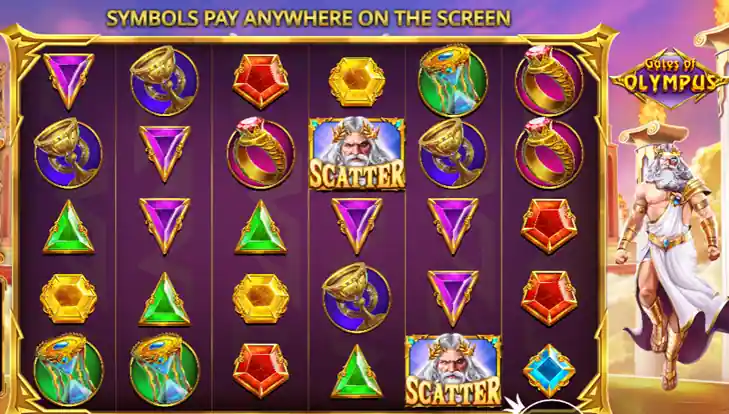
Gates of Olympus is easy to oversimplify as a Zeus-themed slot with bright colours and big multipliers, but the real identity sits in how the board behaves from spin to spin. The game is built around six tumbling reels and a pay-anywhere structure, so the player is reading density, continuation and timing rather than memorising fixed paylines.
That matters because it changes the whole editorial angle. A useful page about this game should not sound like a banner ad. It should explain why the reel set feels mobile, why even calm results can stay interesting for a moment, and why the biggest swings come from sequences that keep breathing before the screen clears.
Why the board is readable from the opening spins
The screen is one of the reasons the game became so sticky. Matching symbols can land anywhere, wins start from eight matching icons, and the board resolves in a way that is readable after only a few spins. You are not fighting hidden information. You can usually see, in real time, whether a tumble still has room to grow.
That readability helps both newer players and experienced ones. A newcomer understands the basics fast, while a more regular slot player can immediately start judging whether a sequence is built on low symbols, premium objects or a moment that may become valuable only if a multiplier joins at the right time.
| Point | Reading |
|---|---|
| Core identity | Tumbles plus random multipliers |
| Why it stands out | The board stays readable even when the pressure rises |
| Main feature | 15-spin bonus round from 4+ scatters |
| Best next step | Move from home into review, RTP and bonus mechanics |
Where the real pressure comes from
The random multiplier symbols are the central pressure point of Gates of Olympus. They can appear with values up to 500x and instantly change the scale of a sequence. In the base game they work like sudden accelerators. In the feature they become even more important because qualifying multipliers are added together before the result is applied.
That is why so many sessions feel uneven in a memorable way. A screen full of motion can still finish modestly if the multiplier never joins a live tumble, while a simpler-looking chain can become the biggest moment of the visit if the timing lands exactly right.
Base game
A multiplier matters only if it attaches to a live winning tumble.
Inside the feature
During the bonus round, the same symbol carries more force because it joins the running total.
How the feature changes the whole tone
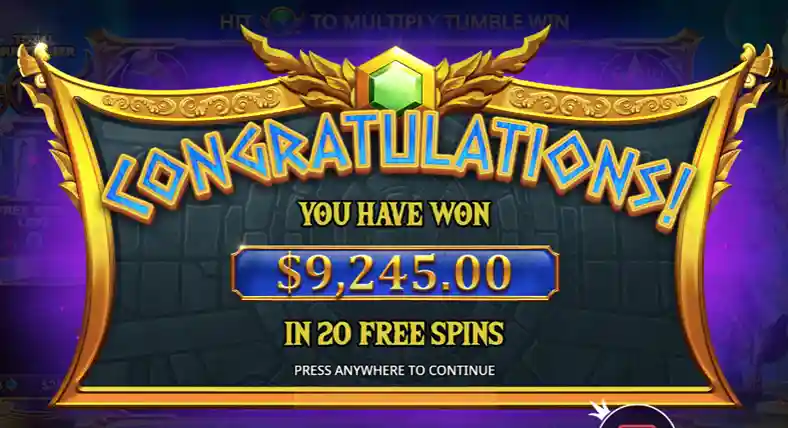
Four or more scatter symbols trigger the bonus round and start the feature with 15 free spins. This is the part players talk about most often, but it is better understood as a continuation of the core mechanics rather than a separate mini-game. The same board logic stays in place; the consequences simply become heavier.
A strong feature is not created by the trigger alone. It needs tumbles that stay alive, symbols with enough weight, and multiplier symbols arriving while the sequence is still open. That combination is what makes the bonus round feel dangerous in a good way instead of merely decorative.
Trigger
The feature begins at four or more scatters.
Real weight
The trigger alone does not guarantee a strong result; sequence quality still decides the tone.
How to read 96.50% without fantasy
Pragmatic Play lists the official RTP at 96.50%, which is useful context but never a promise about a single night or a single bankroll. RTP is a long-run theoretical measure. It tells you something about the mathematical frame of the slot, not what the next twenty minutes owe you.
That distinction matters even more on a title like this. Gates of Olympus puts so much emphasis on feature pressure and multiplier timing that short sessions can swing far above or far below the headline number without contradicting the published RTP at all.
What RTP is
A long-run mathematical measure.
What RTP is not
A short-session promise.
Who tends to enjoy this session shape
The best way to approach Gates of Olympus is usually with a session shape in mind. Sometimes that shape is a short mobile check. Sometimes it is a longer evening built around a fixed bankroll. In both cases the slot becomes easier to read when the player already knows what kind of visit this is meant to be.
That small layer of planning helps because the game can feel hypnotic once tumbles and multipliers start syncing. A preset stop point, a fixed budget or even a simple pause after the feature can stop the session from quietly growing past its original purpose.
How the site is meant to be used
Internal linking should follow the way readers actually think. The home page moves into review and mechanics, the mechanics pages move into risk and comparison, and the practical pages on casino access or responsible gaming still link back to the core reading path.
When that structure works, no page becomes a dead end. The guide feels more like an editorial map and less like a stack of unrelated articles trying to compete for attention.
FAQ
Is Gates of Olympus mostly about the bonus round?
The bonus round is the headline feature, but the base game matters because tumbles and multipliers decide how much tension builds before it arrives.
Why does the home page talk so much about structure?
Because this title is often oversold visually. Structure explains the board, the risk profile and the logic of the session.
Where should I go next?
The strongest route is review, RTP and volatility, multiplier system, and then the bonus round page.