
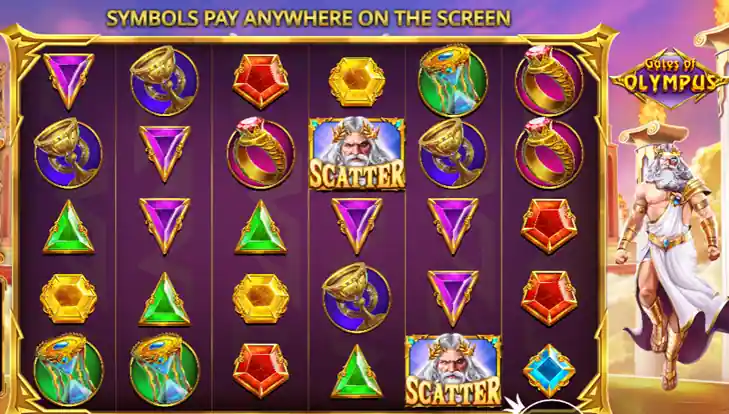
How the symbol ladder is organised
The paytable is clean enough to separate into premium objects and lower-value gems without confusion. Crowns, rings, chalices and hourglasses do more of the heavy lifting, while the coloured gem symbols often keep the board active. That balance is one reason the game feels animated even when the payout line stays modest.
Understanding that symbol ladder changes how you watch a tumble. Not every long chain is a near miss for something huge. Sometimes it is simply a lower-value sequence doing its job of extending the board until a premium object or multiplier arrives to give it real weight.
Why the pay-anywhere rule keeps the game clear
The screen is one of the reasons the game became so sticky. Matching symbols can land anywhere, wins start from eight matching icons, and the board resolves in a way that is readable after only a few spins. You are not fighting hidden information. You can usually see, in real time, whether a tumble still has room to grow.
That readability helps both newer players and experienced ones. A newcomer understands the basics fast, while a more regular slot player can immediately start judging whether a sequence is built on low symbols, premium objects or a moment that may become valuable only if a multiplier joins at the right time.
| Layer | What it tells you |
|---|---|
| Premium objects | These are the symbols that matter most when the board connects well |
| Gem set | Keeps motion high but payout weight lower |
| Pay-anywhere rule | Quantity matters more than line maps |
| Best next step | Use this with the multiplier page |
How the board can stay active on lower-value chains
The tumble mechanic gives the slot its pulse. A win does not always end the moment it appears, because the matching symbols vanish and fresh ones fall into the same frame. That means the emotional rhythm lives inside a resolved spin rather than only between unrelated spins.
For editorial structure, this is useful because it gives the game texture. A quiet stretch does not always feel dead. The board can still suggest movement, and that makes the player stay alert for the point where a seemingly ordinary tumble suddenly becomes meaningful.
Why symbol quality matters when multipliers land
The random multiplier symbols are the central pressure point of Gates of Olympus. They can appear with values up to 500x and instantly change the scale of a sequence. In the base game they work like sudden accelerators. In the feature they become even more important because qualifying multipliers are added together before the result is applied.
That is why so many sessions feel uneven in a memorable way. A screen full of motion can still finish modestly if the multiplier never joins a live tumble, while a simpler-looking chain can become the biggest moment of the visit if the timing lands exactly right.
Base game
A multiplier matters only if it attaches to a live winning tumble.
Inside the feature
During the bonus round, the same symbol carries more force because it joins the running total.

Why long chains still do not promise a huge win
Even without leaning on a marketing label, the slot clearly behaves like a high-variance game. Many spins are there to create movement, context and anticipation rather than immediate return. The bigger emotional spikes tend to arrive unevenly, and that unevenness is part of the design, not a flaw in the build.
Players who prefer constant low-amplitude feedback may find the pacing sharp. Others enjoy the same profile precisely because it makes the bigger moments feel earned. A solid guide needs to describe that honestly so readers can decide whether the shape of the session suits them.
How paytable awareness helps with calmer decisions
The best way to approach Gates of Olympus is usually with a session shape in mind. Sometimes that shape is a short mobile check. Sometimes it is a longer evening built around a fixed bankroll. In both cases the slot becomes easier to read when the player already knows what kind of visit this is meant to be.
That small layer of planning helps because the game can feel hypnotic once tumbles and multipliers start syncing. A preset stop point, a fixed budget or even a simple pause after the feature can stop the session from quietly growing past its original purpose.
Which mechanics page to open after this
Internal linking should follow the way readers actually think. The home page moves into review and mechanics, the mechanics pages move into risk and comparison, and the practical pages on casino access or responsible gaming still link back to the core reading path.
When that structure works, no page becomes a dead end. The guide feels more like an editorial map and less like a stack of unrelated articles trying to compete for attention.
FAQ
Do premium symbols guarantee a huge hit?
No. They improve the quality of the sequence, but timing still matters.
Why do gem chains appear so often?
Because they help keep the board active and readable.
What should I read after this page?
The multiplier page makes the cleanest follow-up.